

Tuesday, February 9, 2010

Transcript of CS#95: Peter Tonon Missionaries of the Poor

March 23, 2009 by Chris Cash  
Filed under Show Transcripts

Transcript of Interview with Peter Tonon about the Missionaries of the Poor. This interview and others like it can be found at http://www.catholicspotlight.com

Listen Now to the audio version of the show.

Donate to the Missionaries of the Poor at The Catholic Company.

http://www.catholiccompany.com/mop

———————————

Welcome to the Catholic Spotlight.

Chris Cash: This is the Catholic spotlight, the show where we’ve talked about what’s new, cool and exciting in the Catholic marketplace. My name is Chris Cash, director of e-commerce for catholiccompany.com, your source for all your Catholic needs. And today in the spotlight we have Peter Tonon, who is a supporter of the missionaries of the poor. He’s a lay supporter, not formally affiliated. But, we wanted to talk today about what is the Missionaries of the Poor and what is it that they do, as well as Catholic companies’ recent involvement in helping to support this awesome apostolate. So, Peter, welcome to the show.

Peter Tonon: Thanks, Chris.

Chris Cash: So, Peter, can you tell us what is the Missionaries — or what is it that they do?

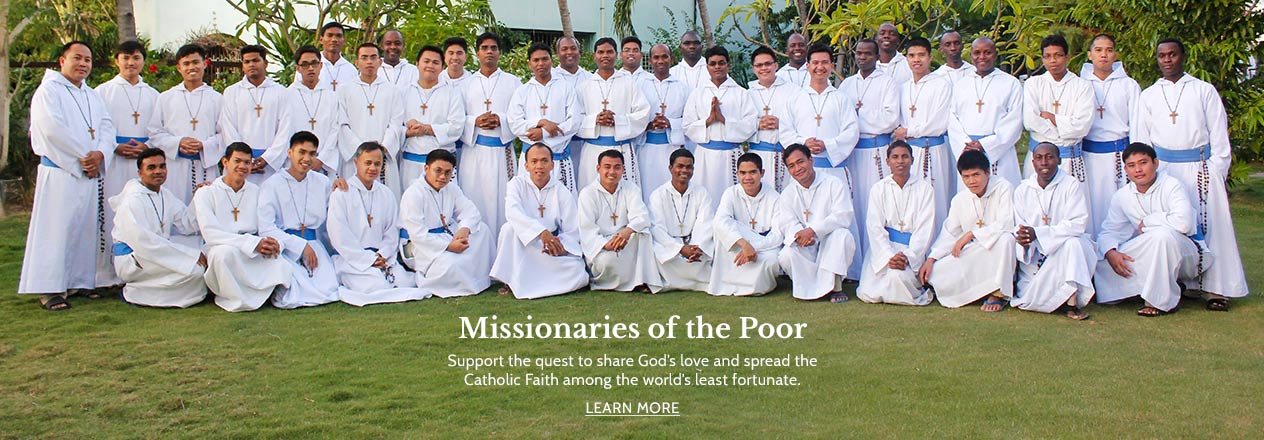
Peter Tonon: Sure. Missionaries of the Poor are a Catholic brotherhood that was started almost 30 years ago by a Jesuit priest by the name of Father Richard HoLung, who at the time was a university professor at Boston College, University of Scranton and University of West Indies, recently when he went back to Jamaica where he was raised. And it is a brotherhood, which is — which its mission is to provide joyful service to the Lord, living a life of beatitudes and service to the poor and needed throughout the world, it’s about the best way I can explain it. Their mission, so to speak, is to preach the crucified Christ and particularly bring good news to those poor and suffering, imitating the joyful service of Christ in the cross. It’s really quite a — as I’ve explained it to some of your listeners, it would kind of a male version of Mother Theresa or — that’s the best way I can explain it.

Chris Cash: That’s a good way to explain it, I think. Now, Father HoLung, what was it that got him started in his work to create the Missionaries of the Poor?

Peter Tonon: He’s really — it’s an amazing story of the activity of the Holy Spirit and, I’ll try to be as economic as possible without giving too long a story. But, his parents emigrated from China. He’s Chinese born and his parents migrated to Jamaica, some 60 years ago, when he was a young boy. It’s been a little over 60 years ago and mainly for a better opportunity of — in economic life. Apparently there were a number of emigrates from China into Jamaica, that time it’s through out the Caribbean and they were Hindus and Buddhists, really mostly what they were. His parents being good Chinese parents, everything was — they sacrificed everything they could so their children can get a top rate education and like there are many other places in the world, the best place to do that was in the Catholic schools. So, they sacrificed and their kids all went to Catholic Schools, Sister of St. Francis was an order and was operating in Jamaica at the time. And, when he was in high school, he accepted Catholicism and became a convert to Catholicism.

And he realized very shortly thereafter he had a calling, a vocation to the priesthood. He went to a Jesuit high school in Jamaica and from there, he went off to Boston College and began his seminary studies, where he eventually received his PhD in Humanities and also was ordained a priest in the Jesuit order. He taught at Boston College for many years and University of Scranton for many years. And then, he was — he came back to Jamaica, 30 years ago or so. And he was teaching at the University of the West Indies at the time. And, interesting there was a kind of an elderly community home that was government sponsored, that was near the university operating. And at the time, I think for Father HoLung being away from the island for so long, he couldn’t believe the radical changes he had seen in the quality of life in his island. Michael Manley at the time was, you know, running a socialist government which came to power in Jamaica and radically transformed the way life operated there in and I think in terms of Father’s perspective, there was a dramatic increase in the poor, the work — the ranks of the poor.

In the time, there was this elderly home next to the burned down and — all the residents were displaced and the government did nothing about it. And, day-by-day, he’d go to his office at the University of West Indies and he just couldn’t take anymore and basically he got his call and he took a young boy by the name of Father O’Brien who was 17-years-old at the time and they just started picking up people from the streets And here’s some 26, 27 years later, they’re a Catholic brotherhood with missions all over the world and some 500 almost 600 brothers that are either professed or are in the process of being professed. And, with the radical growth in the brotherhood, there’s become a need for more priests, so, they’re in the process of forming about another dozen or so priests, in various seminaries around the world, also. So — interesting, really interesting activity of the Holy Spirit working through him. And, thought he was called to life in Academia and really relinquished everything he owns and became the servant of the poor.

Chris Cash: And, currently the Missionaries of the Poor have their mother house in Kingston, Jamaica. They also have operations in India, the Philippines, Haiti, Uganda and Kenya. So, they are truly spread around.

Peter Tonon: Yes. Actually the mother house is in Jamaica, which was where the first apostolate was. There are now, in addition to the mother house, where there is novitiate where there are some 200 brothers now. There are five apostolic that serve, let’s just say, physically-mentally challenged and heavily impoverished residents of Kingston. There’s a home for young children, there’s home for women, there’s a home for AIDS — AIDS patients. So, there are five apostolic in Kingston. About 15 years ago, they opened their first apostolate in Cebu which is in the Philippines — they have two apostolic in the Philippines now, they have two in India, they have one in Uganda for about seven or eight years and recently opened Nairobi, Kenya about three years ago, they had one in Haiti, a town called Cap Haitian which is the second largest city in Haiti. They had that one for about 12 years. And, now actually they have an apostolate in the United States in a little town called Monroe, North Carolina, which is about 15 miles south and west of Charlotte.

Chris Cash: Now, we had hoped to have Father HoLung on to talk with us about what’s going on with the order as well but he got caught up in a crisis in Jamaica trying to help keep abortion from coming to the country. So, unfortunately, we weren’t able to have him on the show today. But Peter has had an involvement with the Missionaries of the Poor for a while. You want to share a little about what you as a lay person have been doing to try to help them?

Peter Tonon: Sure. I first got — I first became involved when I heard a Father preach a homily in our parish house some eight or nine years ago. I’d say probably in the mid 90’s, early 90’s to mid 90’s he started to spend more and more time evangelizing the nature of his mission to the United States, particularly in South Florida and eventually to Atlanta and then to Charlotte. And we had a deacon in our parish that brought whoever was interested in going to serve, to go down there for a week and serve with them at their mother house in Kingston. And, you know when I heard him speak, it was just — clearly there was something there was different about how this man spoke and what he said. And my life at the time had been, let’s just say, from my early college years I have a calling to serve the poor in whatever way possible. Homeless shelters or parishes that we’ve had throughout the various places we’ve lived. And we eventually made a trip there in 2004 and it really — seeing what they do. And seeing the lives of these young brothers choose in joyful service to the poor is just really a real witness in authentic apostolic action. And to us it was really the fulfillment of what the church, the Universal Church really stands for in the mission of Christ from the cross in serving this poor, in a life of beatitudes.

And, almost everyone who we’ve met, and we’ve met over hundreds of people there’ve been — over a hundred, two, three, maybe even four hundred people that have spent either time in the missions had come back to their own neighborhoods and their life is radically transformed. And it’s a beautiful thing to witness so — it just kind of, as I was explaining to the superior here in Monroe, once the spirit calls, it’s just something that won’t let go of you. And no matter how hard or how many things you’re asked to do or called to do, it’s just something that we can’t let go of. It becomes more and more of an integral part of our everyday living from our Catholic faith than ever before. And no matter how much you might want to kind of take a break from it every now and then, the spirit doesn’t let us. So it was my first trip to Cap Haitian about four years ago. And we’re sitting there with Father happened to be there because they were consecrating the new chapel on the mission grounds. And it was a pretty big-to-do. The archbishop was there and there must have been 500 or 600 people from the town and priests from all over the place and various sisters, missionaries there. And the next day we got to spend some time with Father, we were just having conversation with him. And what we realized was just building the Cap Haitian mission was not really what we were called to do.

The Missionaries of the Poor operate in crisis mode everyday of their lives, wherever they are in the world, because as mendicants. And is completely relying on the Holy Spirit for everything they have – clothing, food, buildings, shelter, medicine, whatever it may be. Given the places they are operating, which are some of the most — poorest places that have abject poverty in the world. And now their mission is adjacent to a garbage dump. And slowly but surely, more and more kids who actually live in the garbage dump are living in this mission and going to school in this mission. And so they really are reaching out to truly the poor, the wounded, the oppressed throughout the world, the ones who are forgotten by society. And it’s really — it just, when you actually see the authentic apostolic action live and in person, it radically transforms, you know your thinking and you come back home into our comfortable towns and our comfortable neighborhoods. It’s a real call to apostolic action ourselves. So — but it’s just hard to describe why we’re involved other than simply it’s the Holy Spirit’s calling so….

Chris Cash: Now, you’ve made several trips to help them out right?

Peter Tonon: Well, it’s interesting you say that, you ask that question that way. You know, when you go — when one takes a trip there, it serves in them. And you would stop, you live the life of the brothers, life of a contemplative in action, as they like to call themselves, a semi-monastic. And you think you’re going to “help those people you’re serving but you — what you quickly realized is they’re the ones helping you. The residents that are — reside and are cared for in the apostolate of the Missionaries of the Poor throughout the world, they have the brothers to take care of them everyday and there cannot be a greater caretaker in one’s life, no matter what your needs are than having apostles of Christ caring for you in the most loving, charitable and authentic way possible. So those people are just fine because they are under the care of God in the most beautiful and charitable way. And what you learn quickly is you didn’t they help yourself, they’re the ones that have the effect on you. They’re the ones that live a life of spiritual poverty where between the brothers and the residents, they’re completely dependent and relying on the graces of God for every form of their existence.

And there’s nothing else in their way. So, I go there to edify my faith in life and to grow in faith. And, I remember my first time there was one of the other lay people on the trip said “I come here to learn how to love” and it’s something that stuck with me ever since because it’s true. It’s true, there we can really truly learn how to love like Christ loved, to heal the wounds of the sick, to unchain the chains of the imprisoned. It really is a beautiful apostolate where we can really learn and walk in footstep of the crucified Christ. And for His blessed poor, He’s blessed poor is the ones he came to serve, the sinners, the poor throughout the world. And you really see the universal church in action in a really, really intimate and beautiful way. So — but when you quickly realize you go there not to help them, that they were actually helping you, it then becomes a necessity to go often because the more you come back into this third world that we live in, a world influenced heavily by the prince of the world and the prince of darkness. Only then can you return and go and spend time with where Christ operates, you know, most charitably. And so we go for our souls, we go to edify our Catholic life and to really witness and really see that as we all fight our way around this, you know, the weight of the world and the influences of world and the influences of society. You go to see and you get to rejoice in how watching Christ operate in the most beautiful and authentic way possible in the midst of, you know, Saint Paul says a twisted and depraved generation.

So it’s a wonderful, it’s a working retreat in its most authentic form. But what I realized and my wife realized and I, is this is a place that — it’s so much more about raising money, it’s so much more about — because they do need this, of course they need funds. Because funds allow them to go into different parts of the world with the invitation of many bishops, who by the way are not able to provide them really anything to get them started. I mean it’s wonderful that all these bishops are inviting them to do work there but unfortunately, most of these bishops are in impoverished diocese themselves. They don’t have land. They don’t have buildings. They don’t have monasteries that someone can just walk into. So again, as mendicants, they rely on the good graces of those where they are operating and those in places like the United States and Canada and Great Britain. So they can, you know, use, provide funds that can allow them to do their work. And once you see those funds put in action — and I have this conversation with Father in Haiti that time about how — I asked him, I said you know “If you ever are interested in someone really leading an effort to raise funds, let me know.” And he flatly rejected it, he flatly said “No. No. We have a different mission. And as much as you know I know your heart is sincere. No. We’re just going to continue on our way of doing as we’ve done, which is basically beg.”

So — but there was a project he called me in about a year and a half later, I think once he realized that I had spent enough time in formation with many of the brothers around the world and understood more the cares in what they do and how they do it and why. I offered to see if I could raise money to build a mission, the second mission they had in the Philippines, in Naga. And it was a great exercise for me because I ended up involved in many, many Catholic “fund raising” options opportunities, particularly here in Charlotte where, we’ve been in two parishes and being a new — being an area which is, you know, growing in Catholicism to Catholic campaigns to build parishes. And — which is something completely different. So — but, you know, it was very successful because the response from some of the people I knew around the country, once they understood where I had been and what I had done, it’s amazing how the Holy Spirit operated and then the size of some of the gifts were just astounding. And with those funds and help of some other people, we were able to send funds to the Philippines, to India to buy land for a second mission in an area where Christian churches are being burned everyday, to send money to buy land in Nairobi for the second Africa apostolate. So — and you start seeing you know, the fruits of the Holy Spirit. So, that’s what the more and more involvement with many different things involved in around the world. And eventually to having a lot of participation in the growth of the mission here in North Carolina, at the invitation of our bishop, bishop [ph] Jugas.

Chris Cash: And of course the Catholic Company has recently become involved in trying to help Father HoLung and the Missionaries of the Poor by committing to fund raising for the purpose of sending them catechistical materials. As of our last count, we have sent them over 2700 Catechisms, over 240 bibles, 400 prayer books, over a hundred rosaries and this is an ongoing effort through Catholic Company. So if anybody is interested in helping to provide these materials for Father HoLung, these are all things that Father HoLung has specifically requested of us. That you can find an area in at CatholicCompany.com on donating to Missionaries of the Poor with a list of all the materials that Father HoLung has requested.

Peter Tonon: Well actually, Chris, you know the genus of this was really came from the Catholic Company. When Father was in Charlotte a few years ago, he had an activity to visit the Catholic Company which I thought was an outstanding opportunity for the good Catholic that he is to see that there’s something this beautiful that is actually operating in the United States. Because of course, being someone who has travelled the world and actually lived in the States for many years, of course to see if — he understands the importance of Catholicism in the United States because he feels this is — America is the last stand against Satan. You know, the church in Europe has faltered, the church around it. And America is the place where we can make a stand against Satan. So, if I bought him the Catholic Company, he was really, really edified and overjoyed that actually something like this really existed.

He really had no clue. And — but it was really the initiative of the Catholic Company that came up with the idea of sending materials. Father really didn’t request it, it was something that the principal of the Catholic Company and the employees there, I think responded to and what was said initially was penny Catechisms. It was sent to Jamaica, and eventually was sent to the Philippines and to Africa. And one thing, you know I think, one of the challenges when a lay person is speaking on behalf of the Missionaries of the Poor, it can be — it can tend to just focus solely on service to the poor. But there are also professed brothers, they’re evangelists. They teach and preach and live the faith throughout the world.

And they bring the good news to those who typically would not have the opportunity to hear the good news. And what better way to hear the good news than actually with a penny Catechism that they can actually go into the poor, in the villages of the poor, or teach the residents in their own apostolate the faith in a way that they normally wouldn’t see it. And, by the way, when every other Christian denomination is “intangible” in the same way, you know, so when the archbishop of Jamaica calls and calls Father and is overjoyed when he — because it’s parishes in some poor areas of Jamaica. And saw a penny Catechism and said to the pastor “Where did you get this?” and they said “Well from Missionaries of the poor”. Where do they get them? They get them from the Catholic Company in the United States as a donation. He sees the Holy Spirit and sees the teaching and preaching of the saints come to life to a booklet which is very important. So, it’s a lot more than just service to the poor, it’s the building up of the universal church and starting with the poorest of the poor, who normally wouldn’t have the opportunity to hear the good news, so — Yes, they serve the poor. They’re serving our Lord. They’re serving our Lord by living the faith and teaching the faith. So I think that’s something that those of your listeners who have contributed last summer to that request should know that it’s evangelism in the purest and truest sense also.

Chris Cash: Right. And the request to help out has not ended. It started last summer but it is an ongoing effort and we are continuing to take donations for the Missionaries of the Poor. Anybody who’s interested in making a donation can go over to CatholicCompany.com. And on the side bar you’ll see a “donate to the Missionaries of the Poor” link. And we are — what we do is as the donations come in for the specific items, we will put those items together on a palette and then when we get to a certain number of things on the palette then we put them together to be shipped directly to Father HoLung for use in whatever he sees fit. We have even recently started collecting donations of liturgies of The Hours booklets for all of the young seminarians that he has in formation right now.

Peter Tonon: That’s right and the more brothers that come — it’s a very — It’s important for your listeners to understand how these young brothers are being formed. The young brothers throughout the world that answer the call usually hear it from a parish visit from one of the brothers or priests that live in that country. If those young people are interested, those young men are interested, they come and spend usually a couple weeks in one of the missions and actually see what goes on. And they go home and they’re invited to come back and they spend a year in that mission working, just working and praying. They live the life of monastic order, praying The Hours five times a day. And so when you have, you know, two or three or four hundred brothers around the world, in all these formations, there’s two or three hundred sets of, roughly 175 or 180 a dollar document that ‘s needed. So and then once they spent a year in service, a year of work, they usually return to the mother house, they usually go to the mother house in Jamaica where they spend two years in the mission, which is essentially continue their work in the apostolate and also study.

[Ph]Ken and Log studied in the faith and then at that time, they make their first profession of vows, which is after three years. And then which — they continue their formation, schooling and work for another two years before they make their next profession of vows in five years. They make their final profession of vows at ten years. So, it’s — in addition to the actual work they do, in the apostolate caring for the poor, they also spend a lot of time in formation. And of course, there are others that are called to be priests. And there’s a number of generous contributors, Franciscan University sends the online materials for the further early philosophy and most of the brothers spend time in theological training at the oratory in Toronto, for where they’ll spend their theology and then they’ll spend a year in a seminary, usually in the Philippines. There’s a seminary there in the Philippines which have been very gracious to them. And then they spend, you know, go six months back in Jamaica and then they’re ordained in Jamaica. So I think there’s now — there’s probably 10 or 11 priests now, there’s another dozen or so in formation right now in seminaries. So — and that’s going to be a great advantage to them as they — for their community and for the residents they serve and for the communities they’re serving. So, because many places don’t have priests where they go

Chris Cash: Absolutely. Is there anything else that you wanted to share with our listeners before we finish up the show here?

Peter Tonon: Sure, real quick, you know. I guess maybe to put a plug in for — it’s fantastic that the Holy Spirit has called them and the invitation that they *** [00:29:31] in Australia, they have an apostolate in United States now which is certainly a little different for them. But it’s really a time to, you know we do believe that this is really an answer in call of the Holy Spirit. A time where a lot of people are really struggling economically and — but it’s an opportunity where the brothers feel that they can — they can be instruments and agents for higher calling, so to speak. And even saying what they have done in the small communities, only three or four brothers here right now, what they’re doing is really, really just so a beautiful, beautiful witness to that and attestation to what our church is. So please pray for them, we’re in the process of finding a monastery for them and an apostolate building where they can at least start with a kind of an outreach ministry of service to the poor and underemployed and unemployed here and I tell you predominantly immigrants and poor area of North Carolina.

And it’s wonderful that I’m in the States and it’s a great, great testament to really be obliged with the vibrant life of the universal church around the world. So — and if people want to learn more about the mission, you can plug their website and they love visitors. There’s — they have — in the mother house there’s a place for everyone to stay and you can go and spend as much time as you want living and understanding the life of the Missionaries of the Poor. And also you can look *** [00:31:15] Father, and there’s a couple different series, *** [00:31:17] which you can see I believe on Saturday afternoons, where you can hear Father speak and also see some live clips of some of the places that they serve. So…

Chris Cash: And what is their website?

Peter Tonon: It’s www.missionariesofthepoor.org

Chris Cash: And we will also make sure to include a link to that over on this show notes, just in case anybody has problems finding it.

Peter Tonon: I can tell you Chris, on behalf of Father and all the priests, because I’ve made many trips during the last year. They are extremely grateful for the generous donations and the thoughts of your listeners and customers of the company because it’s really — it’s had a profound effect on the people they serve so…

Chris Cash: Well, thank you Peter for coming on and taking this opportunity to share with us and with our listeners about what the Missionaries of the Poor are and what they’re doing around the world. Please, all of you out there listening if you have a chance, do go over and visit missionariesofthepoor.org as well as stop by Catholic Company and at least consider leaving a donation there for some of the materials that help in their evangelization out in the field, especially if you — we would love to see some people actually go out to Jamaica or some of the other fields, places and have an experience out with learning and helping in the field.

Peter Tonon: It’s highly recommended.

Chris Cash: And thank you very much Peter.

Peter Tonon: Thanks Chris, God bless. I appreciate it.

Chris Cash: God bless, bye.

———————————

Transcript of Interview with Peter Tonon about the Missionaries of the Poor. This interview and others like it can be found at http://www.catholicspotlight.com

Listen Now to the audio version of the show.

Donate to the Missionaries of the Poor at The Catholic Company.

http://www.catholiccompany.com/mop

Speak Your Mind

Tell us what you're thinking...
and oh, if you want a pic to show with your comment, go get a gravatar!